Asia's Leading Law & Technology Review

Category: Contracts Page 1 of 5

TechLaw.Fest 2025: Redefining Legal in the Digital Age

Reading time: 11 minutes

Written by Josh Lee Kok Thong and Elizabeth Thomas

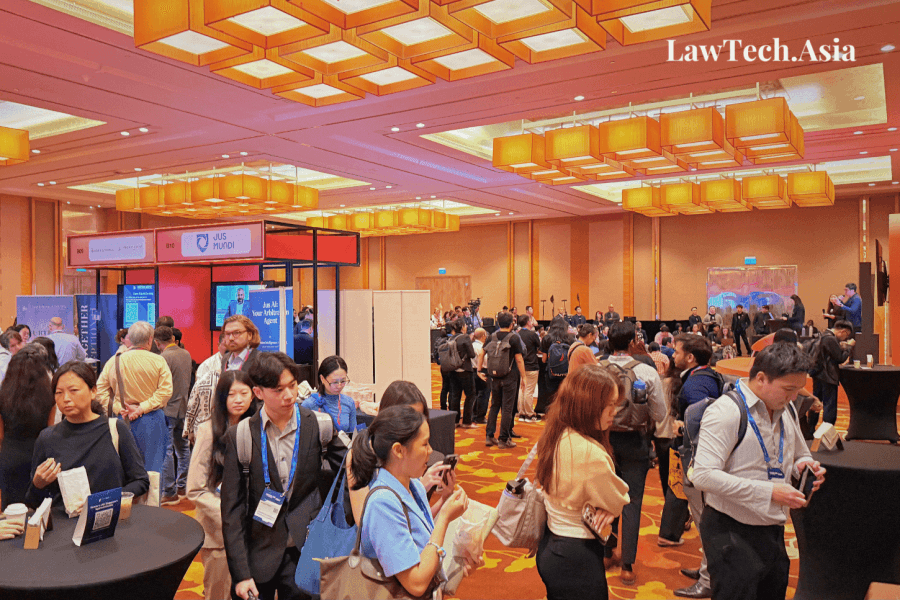
To all but perhaps the most casual tech observer, the annual TechLaw.Fest conference is now a staple of Singapore’s law and technology events calendar. (Even if people do sometimes bungle the name – if one were given a dollar for every variant of “TechLaw.Fest” out there, one could buy himself a nice lunch). Few people, however, can recall the conference’s humbler roots: it first began as the “International Conference on Electronic Litigation” in 2011, and only evolved into the TechLaw.Fest we know (and love) in 2015. 

Nevertheless, over its past 10 iterations, TechLaw.Fest has built a name for delving into two simple but complex notions: novelty (what is new or just over the horizon) and foreseeability (what new impacts can we foresee on the world of law and technology). Thematically, the 10th edition of TechLaw.Fest opens perhaps a third dimension – one of re-definition – as TechLaw.Fest 2025 called upon delegates to “redefine legal in the digital age”. 

Every year, it is LawTech.Asia’s privilege to be selected as Media Partner to TechLaw.Fest. In this article, as the legal community gears up once more for TechLaw.Fest 2026 season (expected to be in a few months), we seek to re-capture the highlights of “Asia’s premier forum on all things concerning law and technology”, and bring our readers once more the insights, energy and imagination of TechLaw.Fest 2025. 

How are Non-Fungible Tokens Stolen?

Reading time: 13 minutes

Written by Marilyn Sim | Edited by Josh Lee Kok Thong

We’re all law and tech scholars now, says every law and tech sceptic. That is only half-right. Law and technology is about law, but it is also about technology. This is not obvious in many so-called law and technology pieces which tend to focus exclusively on the law. No doubt this draws on what Judge Easterbrook famously said about three decades ago, to paraphrase: “lawyers will never fully understand tech so we might as well not try”.

In open defiance of this narrative, LawTech.Asia is proud to announce a collaboration with the Singapore Management University Yong Pung How School of Law’s LAW4032 Law and Technology class. This collaborative special series is a collection featuring selected essays from students of the class. Ranging across a broad range of technology law and policy topics, the collaboration is aimed at encouraging law students to think about where the law is and what it should be vis-a-vis technology.

This piece, written by Marilyn Sim, seeks to discuss a question that has as of late not yet been dealt with in most jurisdictions – how are Non-Fungible Tokens (“NFTs”) stolen? More specifically, what does it mean for an NFT to be stolen in fact, and if it can indeed be stolen, what are the chances of an individual reclaiming his or her NFT? This paper surveys available material and comes to the finding that NFTs can be stolen in direct and indirect ways.

TechLaw.Fest 2020 Cyber Edition – A virtually transformative conference experience

Reading time: 11 minutes

By Josh Lee | Edited by Elizaveta Shesterneva

Supported by: Lenon Ong, Utsav Rakshit, Benjamin Peck, Ong Chin Ngee, Tristan Koh

“In a year when a certain pesky virus turned the world upside down, how can a conference engage, encapsulate and elaborate upon all of the disruption seen in one year?”

This must have been the key question on the minds of the planners of TechLaw.Fest 2020, as they went about organising Asia’s largest law and technology conference. What followed was a signature conference held with a virtually (pun intended) uniquely signature.

In this article, LawTech.Asia will take our readers on a quick recap of TechLaw.Fest 2020, as we look forward to another exciting edition of TechLaw.Fest in 2021. LawTech.Asia is grateful for our ongoing strategic media partnership with the Singapore Academy of Law (“SAL”), and for the opportunity to be a media partner for TechLaw.Fest once again.

The Use, Issues and Policies of Legal Technology for Lawyers and In-House Counsel

Reading time: 19 minutes

Written by Johanna Lim Ziyun (Associate Author) | Mentored by Nisha Rajoo | Reviewed by Edmund Koh

LawTech.Asia is proud to have commenced the third run of its popular Associate Author (2020) Programme. The aim of the Associate Authorship Programme is to develop the knowledge and exposure of student writers in the domains of law and technology, while providing them with mentorship from LawTech.Asia’s writers and tailored guidance from a respected industry mentor.

In partnership with the National University of Singapore’s alt+law and Singapore Management University’s Legal Innovation and Technology Club, five students were selected as Associate Authors. This piece, written by Johanna Lim and reviewed by industry reviewer Edmund Koh (China Telecom Asia Pacific), marks the third thought piece in this series. It scans the landscape of lawyers and technology, and sets out steps that lawyers should take to meet a future technologically-driven paradigm.

Smart contracts and blockchain-based crowdsourced arbitration: A primer

Reading time: 11 minutes

Written by Tomoe Suzuki (Associate Author) | Mentored by Amelia Chew | Reviewed by Paul Neo 

LawTech.Asia is proud to conclude the second run of its Associate Author (Winter 2019) Programme. The aim of the Associate Authorship Programme is to develop the knowledge and exposure of student writers in the domains of law and technology, while providing them with mentorship from LawTech.Asia’s writers and tailored guidance from a well-respected industry mentor.

In partnership with the National University of Singapore’s alt+law and Singapore Management University’s Legal Innovation and Technology Club, five students were selected as Associate Authors. This piece by Tomoe Suzuki, reviewed by industry reviewer Paul Neo (Chief Operating Officer, Singapore Academy of Law), marks the third thought piece in this series. It examines the rise of blockchain-based crowdsourced arbitration platforms.

Introduction 

An earlier piece on “A brief analysis of the legal validity of smart contracts in Singapore” (“A Brief Analysis) by Louis Lau on LawTech.Asia has explored the issues surrounding the adoption of smart contacts in terms of validity. This piece seeks to build on the aforementioned piece and add on to readers’ understanding of issues that arise in the implementation of these contracts and solutions that have arisen. 

In particular, this article will compare various dispute resolution methods such as court-based litigation, mediation, arbitration (administered by arbitral institutions) to blockchain-based crowdsourced arbitration platforms (“BCAPs”) that have emerged in recent years. This piece will also provide a relatively abstract overview of how BCAPs work, the use cases they may be suited for, and highlight some of the challenges faced in increasing the adoption of smart contracts and BCAPs. 

Page 1 of 5

Powered by WordPress & Theme by Anders Norén