
Written by Josh Lee Kok Thong and Elizabeth Thomas
To all but perhaps the most casual tech observer, the annual TechLaw.Fest conference is now a staple of Singapore’s law and technology events calendar. (Even if people do sometimes bungle the name – if one were given a dollar for every variant of “TechLaw.Fest” out there, one could buy himself a nice lunch). Few people, however, can recall the conference’s humbler roots: it first began as the “International Conference on Electronic Litigation” in 2011, and only evolved into the TechLaw.Fest we know (and love) in 2015.
Nevertheless, over its past 10 iterations, TechLaw.Fest has built a name for delving into two simple but complex notions: novelty (what is new or just over the horizon) and foreseeability (what new impacts can we foresee on the world of law and technology). Thematically, the 10th edition of TechLaw.Fest opens perhaps a third dimension – one of re-definition – as TechLaw.Fest 2025 called upon delegates to “redefine legal in the digital age”.
Every year, it is LawTech.Asia’s privilege to be selected as Media Partner to TechLaw.Fest. In this article, as the legal community gears up once more for TechLaw.Fest 2026 season (expected to be in a few months), we seek to re-capture the highlights of “Asia’s premier forum on all things concerning law and technology”, and bring our readers once more the insights, energy and imagination of TechLaw.Fest 2025.
Day 1: Reframing law and justice in an AI era
The first day of TechLaw.Fest 2025 set the tone of re-imagination. Delivering the welcome remarks, the Honourable Justice Aidan Xu reflected on a decade’s editions of TechLaw.Fest – and how the conference’s evolution reflected Singapore’s trajectory as a hub for legal innovation. With participation now spanning over 100 countries, Xu J traced the conference’s longstanding engagement with emerging technologies, from blockchain to cybersecurity, AI, and data privacy. At the same time, he emphasised a consistent theme: that technological progress must remain anchored in people and key values (such as inclusivity, ethicality, and future-readiness). Xu called upon delegates to build a legal system that “moves at the speed of innovation while holding fast to the values of justice”.
Senior Parliamentary Secretary Eric Chua, attending as Guest of Honour, spoke about the need for an active application of agency. SPS Chua observed that TechLaw.Fest 2025 reflected urgency (in how technology is developing at an unprecedented pace) and opportunity (in how the legal industry is, and should remain an active stakeholder navigating complex legal problems). His main message was that the law must evolve dynamically with the times, and that legal professionals play a critical role in giving confidence to companies to innovate responsibly by deftly navigating legal issues and norms. In support, SPS Chua cited examples from the space of online safety and generative AI.
- In online safety, he observed how while Singapore ranked as one of the safest places in the world physically, Singaporeans faced very real risks online (with 74% of Singaporeans encountering at least one instance of online harm in 2024). In response, SPS Chua noted how Singapore would be establishing a new Online Safety Commission in 2026 to provide timely relief for online harms and allow victims to hold perpetrators accountable in court.
- In generative AI, SPS Chua noted that this was a space for opportunity and responsibility. While generative AI use could boost productivity (SPS Chua shared that Singaporeans are one of the highest per capita users of generative AI, with more than 50% already using it in daily workflows), there was also a need for responsibility (as users must remain accountable for its use, and not let its use replace professional judgment). Legal systems should thus be guided by the need for “thoughtful adoption”, and that legal frameworks must balance the convenience of AI and the need to protect consumer interests.

The Honourable Chief Justice Sundaresh Menon’s encyclopaedic Opening Keynote provided the conceptual anchor for the day. He opened his speech by highlighting two trends: the complexification of technology, and the complexification of regulations.
- On technology, Menon CJ observed remarkable advancements in technology not just at the frontiers, but also what average consumers could access. In this regard, complexity emerges not simply from the breathtaking pace of breakthroughs, but from persistent and inherent attributes in AI systems – such as opacity and their ability to confabulate (i.e. hallucinate).
- On regulations, Menon CJ focused on complexity arising from transnational oversight and enforcement. He observed how regulatory complexity could lead to weak and ineffective oversight, increased costs, and an increased propensity for regulatory arbitrage.
Turning to the impact on law, Menon CJ identified three fronts for re-imagination: the modernisation of the justice system, the transformation of legal services, and the adaptation of legal frameworks to emerging domains such as crypto-assets, autonomous vehicles, and data-intensive technologies.
Menon CJ’s speech was both forward-looking and grounded. He highlighted the risks posed by opaque and complex AI systems, underscoring the need for explainability, oversight, and cross-border regulatory coordination. At the same time, he drew a clear boundary around the role of technology in adjudication. While AI could enhance processes, it could not and should not replace the human elements of judging, including empathy, moral reasoning, and institutional legitimacy. Menon CJ called for a calibrated regulatory response that combines clarification of existing law, targeted legislative intervention, and the continued development of soft-law instruments, while avoiding excessive precaution that could stifle innovation. Underpinning this was a broader message on professional adoption and adaptation: that it is now a must for legal practitioners to “embed digital literacy” as a broader set of tools of a lawyer’s trade. Adding to this, Menon CJ encouraged judges, lawyers and regulators to embrace two further mindset shifts: a commitment to multi-disciplinarity as a defining theme of the legal profession, and adopting a transnational outlook by drawing on the wealth of knowledge beyond Singapore.

The breakout panel discussions then translated these themes into practice.
The panel on “AI and Access to Justice” examined how generative AI might help enhance the accessibility of the law to the layperson. Speakers pointed to experimental deployments, including testing AI reasoning on landlord-tenant disputes and tools designed to support self-represented litigants in navigating procedural complexity. Yet, panellists were also consistent on the need for sensible limits. One example raised was that judicial functions should broadly remain irreducibly human, especially in cases requiring empathy and discretion.
The panel on “Managing the Machine: Shaping the Future Legal Workforce” shifted focus to organisational and professional implications. Panellists discussed the considerations guiding on when firms should build bespoke AI systems or procure off-the-shelf solutions, with consensus that governance safeguards – both internal- and external-facing – are critical regardless of approach. Panellists also identified baseline requirements like training, human-in-the-loop reviews, sandbox testing, and data management controls.
- The conversation also reflected a structural shift in the profession. Panellists noted that multidisciplinary teams that integrate legal, technical, and operational expertise are fast becoming standard (and not just a competitive advantage). Within this environment, however, there was a consensus among panellists that the role of lawyers, and the accountability they represent and uphold, remained a core part of the industry.
- Perhaps most provocative was an exhortation by a panellist to explore “blue-ocean” uses of AI in law firms – new opportunities for law firms to offer heretofore unoffered services. Examples of such blue-ocean uses include helping client companies operationalise legal advice, conducting horizon-scanning in specific legal areas; and helping client companies with completing back-end work (such as translating regulatory requirements in standard operating procedures for companies).
A comparative perspective emerged in the “Global Approaches to AI in Courts” panel. Representatives from Taiwan, India, Singapore, and Canada outlined differing institutional approaches. These ranged from assistant-only deployments to administrative uses and more cautious positions on generative AI in adjudication. Despite variations in regulatory posture, there was nevertheless a certain convergence of principle: that whilst efficiency gains are valuable, the bastions of legitimacy, transparency, and human judgment remain central to the administration of justice – and it is in the hands of present-day judges and lawyers to continue holding fast to these ideals.
Taken together, Day 1 reflected a profession in transition amidst re-imagination. Whilst the narrative of AI reshaping workflows and institutional design resonated throughout the various sessions (and hallway discussions thereafter), technology integration remains (and should remain) bounded by enduring legal values. Singapore’s approach, combining technological experimentation with consistent and pragmatic governance, reflects an attempt to sensibly balance these imperatives.
Day 2: Governing technology, shaping outcomes
The second day expanded the conversation beyond the courtroom and the legal profession to encompass governance, markets, and society. The sessions and panels across the day brought together policymakers, regulators, practitioners, and youth voices to examine how technological change is challenging existing legal frameworks.
Justice Kwek Mean Luck opened the day with an address on the transformation of legal practice. Kwek J highlighted developments such as AI-assisted litigation, automated case management, and digital dispute resolution, positioning them as tools that can enhance efficiency and broaden access. To that end, Kwek J announced the launch of a new natural-language-based Q&A search function on LawNet, powered by the GPT Legal model and developed by the Infocomm Media Development Authority of Singapore, the Ministry of Law, and the Courts. However, his emphasis remained consistent with themes discussed on Day 1. Technology augments but does not replace human judgment, and its deployment must be guided by ethical oversight and a commitment to fairness. He reminded delegates that “every user must take responsibility for the outputs drawn from AI”, and to be “ultimately responsible for your own work”.

This was followed by a keynote from then-Commissioner John Edwards of the UK’s Information Commissioner’s Office (“ICO”). Commissioner Edwards focused on global challenges in data governance and privacy amidst an uncertain global order, and shared about how the ICO was navigating the current climate. In this regard, Commissioner Edwards observed that “all economic activity is built on trust”, and his office’s mandate is to apply existing laws to emerging technologies to reduce regulatory burdens while securing public trust.
- Drawing from his deep experience, Commissioner Edwards traced the various developmental threads of data protection law in various jurisdictions (such as the EU and US), and observed how the core principles of data protection law continued to remain relevant despite multiple technological evolutions (such as computing, the invention of the Web, smartphones, social media, blockchain and AI). He noted that the ICO’s mission is to continue providing certainty upfront on how these principles – such as data minimisation and purpose limitation – apply to new technologies and factual matrices, and in turn, provide companies an avenue to experiment before deploying these technologies with confidence in Europe.
- Commissioner Edwards also touched on cross-border data transfer regulations, and highlighted the importance of greater interoperable mechanisms enabling free and trusted data flows between jurisdictions. Commissioner Edwards commended Singapore for being a regional pioneer in this space, and observed Singapore’s potential in bridging Western and Asian regulatory attitudes towards data transfers.
- In closing, Commissioner Edwards noted how the UK and Singapore were analogous in acting as bridges to wider regions (i.e. the Europe for UK, and wider Asia for Singapore). He called upon delegates to come together to build common approaches to emerging issues, and sought greater open dialogue and regulatory conversations between both jurisdictions.
Panel discussions on Day 2 examined pressure points in certain specific technology and practice areas.
The panel on “AI and Copyright” considered how generative AI was disrupting traditional concepts of authorship and ownership. Panellists discussed whether existing copyright regimes remain adequate, particularly in relation to training data, licensing structures, and attribution. Examples from AI-generated music and visual art illustrated the practical stakes, with panellists noting the risk of both under-protection and over-regulation.
The panel on “Cross-Border Digital Trade” panel addressed the intersection of technology and global commerce. Topics included blockchain-enabled transactions, smart contracts, and the enforceability of digital agreements across jurisdictions. Panellists highlighted regulatory fragmentation as a key challenge, particularly in areas such as data protection compliance and digital customs regimes. Emerging developments, including tokenised assets and decentralised finance, reinforced the need for regulatory approaches that are both adaptive and coordinated.
Finally, the panel “AI in Legal Practice” returned to operational considerations within firms. Discussions centred on tools such as predictive analytics, automated contract review, and advanced legal research systems. These applications were presented as capable of improving efficiency and surfacing risks that might otherwise be missed. At the same time, panellists noted ethical concerns, including bias and accountability. The consensus was that AI operates most effectively as a complement to, rather than a substitute for, professional expertise.
A further distinctive feature of the day was the TLF x Youth Panel on online safety, which introduced perspectives from a range of youth participants navigating digital environments directly. The discussion covered issues such as cyberbullying, misinformation, algorithmic amplification, and mental health impacts. Panellists emphasised that policy responses must incorporate youth perspectives, both in design and implementation. Panellists – who came from various backgrounds, including in policy-shaping and content production – suggested solutions such as stronger digital literacy initiatives, enhanced privacy tools, and more responsive content moderation frameworks.
A profession and system being re-defined
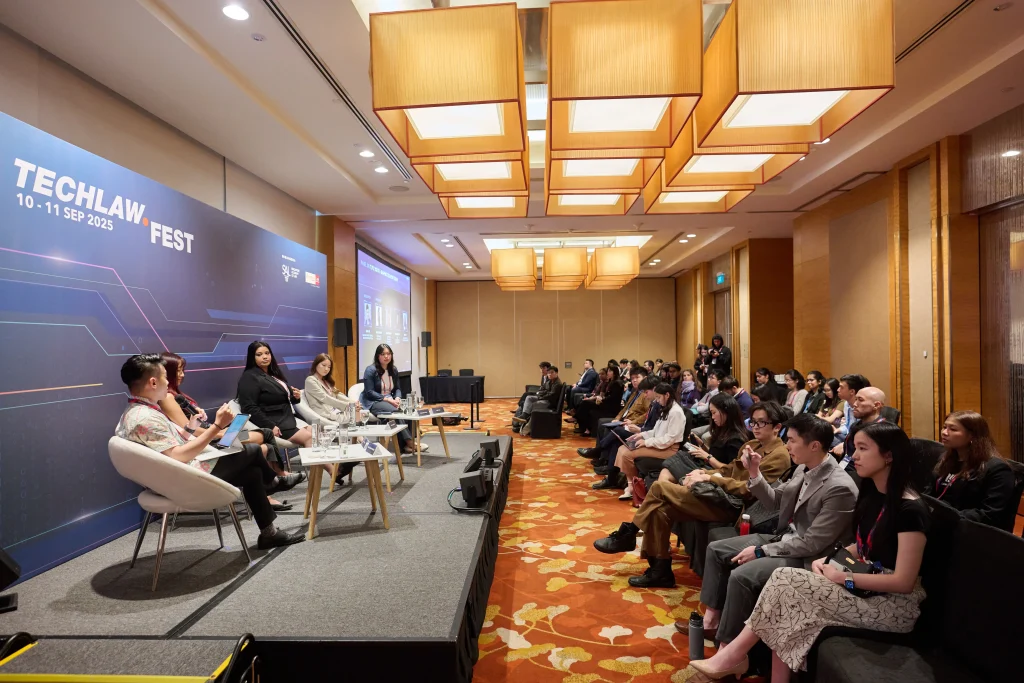
The theme of re-definition continued outside the panel sessions. In the exhibition halls (now twice the size compared to 2024), vendors of all shapes and sizes demonstrated re-definition in action – how technologies like AI could be applied to different aspects of legal work to make lives simpler for legal professionals and the clients they serve. Even in this lively area, lightning talks on all topics related to law and technology were taking place on the Tech Talks and Tech Bytes stages.
- For instance, a panel on “The AI Playbook for World-Class Legal Teams” saw panellists sharing experiences on how to encourage innovation in legal teams, while ensuring appropriate guardrails. Panellists shared, in essence, about value- and values-driven organisational sandboxing: giving legal teams safe spaces to innovate and experiment, highlighting the gains (value) from it, while being guided by guided by internal governance guardrails and rules (values).
- In another session on “Digital Lawyering – Transforming Legal Service Delivery with AI Across APAC”, the Asia-Pacific Legal Innovation and Technology Association (“ALITA”) launched the 2025 State of Legal Innovation in the Asia-Pacific Report. Now in its fourth edition, the Report (developed by ALITA in collaboration with LexisNexis) studied the use of legal technology and AI in law firms and legal departments across the Asia-Pacific and provided a comparative overview of regional legal technology ecosystems.

Yet what struck the biggest impression the most were the delegates who thronged the hallways. Within minutes of walking in, one would easily rub shoulders with lawyers, judges, policymakers, technologists, academics, and even passionate youths – all seeking to draw inspiration from the technological possibilities on display; and each shaping their own vision of what a re-defined legal industry should look like in the digital age.


These delegates show that the future of law and technology is not defined solely by tools, policies, or laws and regulations. It is shaped by the interaction between systems and the people who design, regulate, and use them. The re-definition of law and technology must therefore, at the final count, embrace a desire of service – to serve users of the legal system, and the societies that depend on it. It is a spirit we hope – along with the twin quests for novelty and foreseeability – will continue to carry TechLaw.Fest into its next iteration, and into its next decade of existence.