
Asia's Leading Law & Technology Review

Category: Lawyers Page 12 of 17

Zegal 2.0: Product Report

Reading time: 6 minutes

Written by Tristan Koh, Utsav Rakshit | Edited by Josh Lee

Introduction

Zegal is a collaborative cloud-based legal technology platform that aims to transform the way legal services, such as document generation and legal workflow management,  are delivered. Formerly Dragon Law, it has come a long way from starting off purely as an automated contract generation software. Today, the platform integrates automated contract generation seamlessly with legal workflow management in the cloud.

LawTech.Asia was given a chance to meet with Zegal Singapore’s Co-founder, Stephan Hablutzel, and view an in-depth product demo of Zegal’s latest product, Zegal 2.0.

Stephan formerly worked as a top-level executive in several MNCs. From his frequent use of legal services in the past, he and the Zegal team have used their deep understanding of common pain points in legal services to create a product that is client-centric. In particular, Zegal makes legal services far more accessible to small and medium-sized companies and eschew the traditional reservation of full-scale legal services for large corporations.


Legal Hackers APAC Summit 2018 – A Summary

Reading time: 7 minutes

Written by Cai Xiaohan | Edited by Josh Lee

From 16-17 November 2018, LawTech.Asia co-organised the Legal Hackers APAC Summit together with SG Legal Hackers and the Singapore Academy of Law. This saw over twenty Legal Hackers chapter organizers from at least ten different countries in the Asia-Pacific region converge in Singapore to discuss the latest developments in law, technology and innovation in the APAC region.

The APAC Legal Hackers Summit 2018 welcome page. (Image credit: Legal Hackers Singapore)

#LegalHackers Profile: Eric Chin, Legal Hackers Melbourne

Reading time: 5 minutes

Interview by Huiling Xie | Edited by Amelia Chew & Emily Tan

In November 2018, LawTech.Asia co-organised the inaugural APAC Legal Hackers Summit alongside Singapore Legal Hackers and the Singapore Academy of Law’s Future Law Innovation Programme (FLIP), bringing together Legal Hackers chapter organisers in the region to share insights on legal innovation across APAC. Legal Hackers is a global movement of lawyers, policymakers, designers, technologists, and academics who explore issues and opportunities where technology can improve and inform the practice of law, and where law, legal practice, and policy can adapt to rapidly changing technology. In this series, we profile Legal Hackers chapter organisers who are driving legal innovation in their cities.  

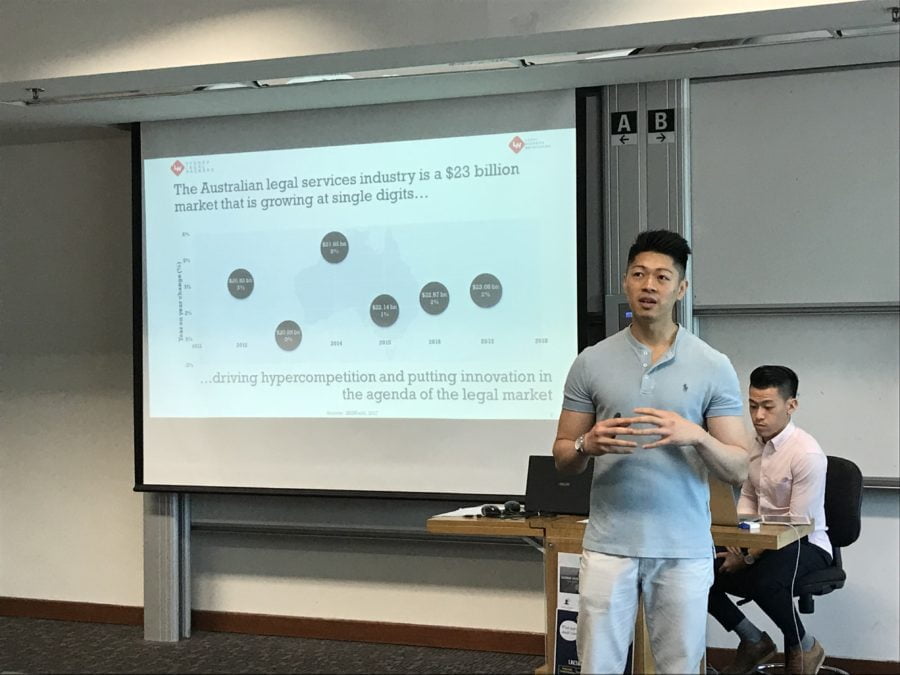
Here, Eric Chin, a strategy consultant for the legal industry and chapter organiser at Legal Hackers Melbourne, shares his insights on where the legal industry is headed.

You started your career in the consulting industry, providing services to a number of professional services firms across industries such as law, engineering, and accounting. What about the legal industry drew you to carve out an independent practice specialising in consulting for law firms?

The legal market is in a very unique position in its history. I see a lot of opportunity in helping law firms, NewLaw firms and LegalTech firms navigate the changing market.

Taking a long-term view, the industry has seen a few distinct phases in how competition has evolved. The concept of practice groups emerged in the 1980s. This then progressed to scale and geographic expansion in the golden age of globalisation of the 1990s. The 2000s saw the outsourcing trend engulf the market as legal process outsourcing companies and legal managed service firms (NewLaw firms) were conceived. In this decade, the 2010s, the technological trend gave birth to LegalTech firms. Not to forget also the entry of the Big Six accounting firms in the 1990s that culminated in the Big Five becoming one of the largest in the world in the early 2000s. Since the 2010s, we have seen the Big Four establishing their legal offering in various forms.

Rajah & Tann Technologies Acquisition of LegalComet

Reading time: 4 minutes

Written by Marc Chia | Edited by Amelia Chew

Rajah & Tann Technologies (R&T Technologies), the dedicated tech arm of Rajah & Tann Asia recently completed its acquisition of LegalComet for an undisclosed sum.

Rajah & Tann has long been one of the leading law firms in Singapore. In more recent times, the firm has begun exploring the delivery of tech-augmented legal services, most notably through the setup of Rajah & Tann Technologies in 2017. This move has placed Rajah & Tann alongside prominent international names such as Linklaters and Allen & Overy, both of which are recognised for their strong innovation efforts. Linklaters and Allen & Overy have set up incubators in order to nurture and work alongside legal tech startups to change the business of law.

In contrast, R&T Technologies’ current model of operations is not based on incubation of startups but rather acquiring and offering capabilities in legal tech itself. The team has identified six key areas of expertise: Data Breach Readiness & Response; Cybersecurity; Virtual Law Academy; E-Discovery; LegalTech; and RegTech. R&T Technologies’ offerings are designed for both their existing clientele as well as other law firms seeking to implement legal tech solutions. Headed by Rajesh Sreenivasan and Steve Tan as Directors; Wong Onn Chee as Technical Director; and Ong Ba Sou as Chief Technology Officer, the R&T Technologies team brings with them a broad range of experience in law, technology and project management.

RDO x LawTech.Asia: International Commercial Courts and the Role of Technology

Reading time: 4 minutes

Written by Maryam Salehijam (RDO) | Edited by Josh Lee

International commercial courts (“ICCs”) have been gaining attention as a new forum for the resolution of commercial disputes. Notable examples include the London Commercial Court, the Dubai International Financial Centre Courts (“DIFCC”), the Netherlands Commercial Courts, and the Singapore International Commercial Courts (“SICC”). There are commentaries and articles that discuss the purpose of ICCs and how they complement arbitration in the international dispute resolution landscape. This article does not intend to wade into that well-traversed discourse. Suffice it to say that ICCs broadly serve the following purposes:

  1. Provide a platform for cases that are better suited for a process that is “relatively open and transparent, equipped with appellate mechanisms, the options of consolidation and joinder, and the assurance of a court judgment”[1];
  2. Allow disputants to avoid problems faced by arbitration (e.g. increasing judicialization and laboriousness in process resulting in delays accompanied by rising costs, unpredictability in the enforcement of arbitral awards, or lack of consistency in arbitral decisions)[2]; and
  3. Facilitate the harmonisation of commercial laws and practices.

As ICCs are a modern development, they have attempted to incorporate modern technologies to enhance their ability to deal with the cross-border, large-scale nature of the cases that they deal with. This article takes a quick look at the following two questions:

  1. To what extent should the adoption of technology be a priority for an ICC? 
  2. Would ICCs be able to leverage the upcoming wave of online dispute resolution (“ODR”)? 

Page 12 of 17

Powered by WordPress & Theme by Anders Norén